
New Comics #3--Part 1. The Cook and Mahon Kerfuffle and A Mystery Solved
New Comics #3 is noteworthy for several reasons. The Major’s comics magazines are beginning to encourage a nascent comics industry with a new comic magazine appearing—The Comics Magazine and Harry Chesler forming his comics shop sometime in 1935 or 36. Samuel M. Iger, who would produce original comics with Will Eisner by July 1936 has a one page of comic shorts and it was the last magazine for the Major with William Cook and John Mahon as they would leave to publish The Comics Magazine.
My overall impression of New Comics #3 is that the magazine seems to have hit its stride especially with the contributions of Vin Sullivan, Sheldon Mayer and Siegel and Shuster’s “Federal Men.”
However, there is a sense that the magazine was struggling. There are several comics that seem last minute and not fully developed and several pages that come across as filler probably necessary to fill 64 pages. Given Cook and Mahon’s departure that would seem probable. Much has been made of their departure casting the Major as a poor businessman but a detailed look tells a somewhat different story.
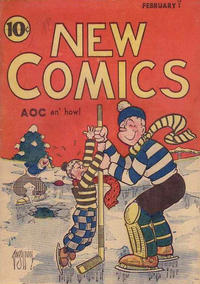
New Comics #3 appeared on newsstands February 1, 1936, 85 years ago. The cover art by Vin Sullivan, a simpler graphic style than the More Funs is aimed to catch the reader’s eye among the other newsstand offerings. Sullivan’s character Jibby Jones is featured bullying a younger kid by being taller and able to reach higher on the hockey stick and thus call dibs. That theme might not read well in today’s climate.
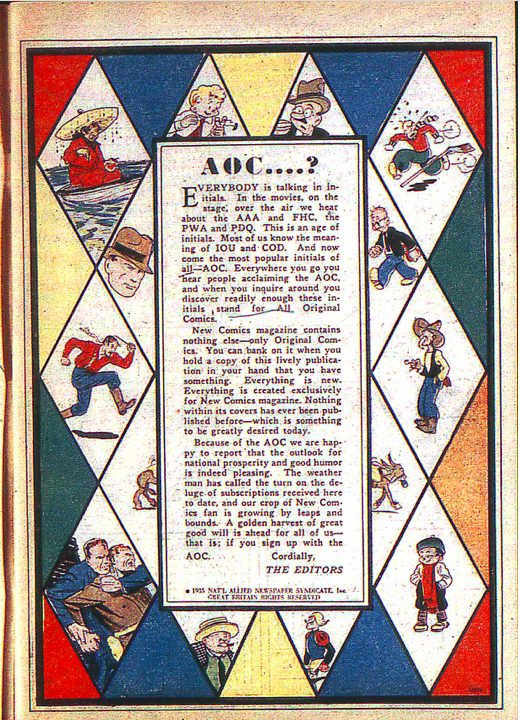
The SM distribution logo continues in the upper corner. The cover is orange/red with large bold yellow NEW COMICS and underneath AOC an’ how! in bold black underneath. What is AOC you ask? According to the Editor’s note on the first page AOC stands for All Original Comics.
“New Comics magazine contains nothing else—Only Original Comics. You can bank on it when you hold a copy of this lively publication in your hand that you are getting something. Everything is new. Everything is created exclusively for New Comics magazine. Nothing within its covers has ever been published before—which is something to be greatly desired today.”
All original comics is an important selling point. Even though there were original comics magazines earlier, the Major’s comics were the only ones currently and consistently on the newsstands. Although some of the magazines contained a few original comics they consisted of mostly reprints from newspapers. MWN believed that all original comics was the way to go for comics magazines and he was more than proved right especially as other publishers began to follow his lead.
The inside cover features the masthead which is the same as More Fun #7 & 8, and New Comics #1 & 2 with Malcolm Wheeler-Nicholson as Editor and Publisher, William Cook as Managing Editor, John Mahon as Business Manager and Vincent A. Sullivan as Assistant Editor.
Cook first appeared in New Fun #3 with a story, “The Magdelena Kid.” By New Fun #6, Cook was Managing Editor and in New Comics #1 John Mahon appeared on the masthead as Business Manager.
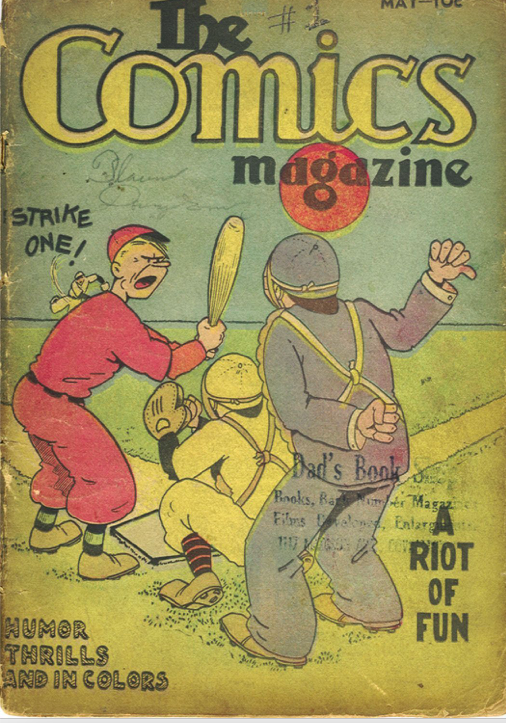
When More Fun #9 was on newsstands March 5, 1936 they were no longer on the masthead and 10 days later they published The Comics Magazine which had a similar look and content to New Comics including some of the same artists and some of the Major’s material that appeared in both magazines. I don’t believe that the simple explanation of the Major owed them money is accurate.
From what I’ve encountered so far, every comic book history maintains Cook and Mahon left the Major’s company “taking” a number of artists with them due to the Major’s poor business acumen. The supposition has always been that it had to do with payment of debts owed. The wording in these histories is always slanted with phrases like “fed-up” etc. The picture that comes to mind is a mass exodus of people running out the door. That’s not accurate and it’s a lazy way to describe a much more complicated situation.
The Comics Magazine. Cover: attributed to Vin Sullivan
As is usual with most events, there were a number of aspects that lead to more questions. The artists weren’t necessarily in the office. Some of the artists were now involved with “shops” and it was more of a question of which “shops” were going with which magazine. I’ll get into that more in the next few postings.
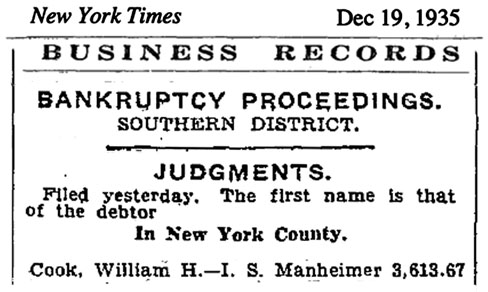
One intriguing clue from David Saunders in his website Pulp Catalog notes a bankruptcy proceeding against Cook from The New York Times in December 19, 1935.
Where was Cook getting the funds for the magazines if he was already in debt and in bankruptcy court? That doesn’t seem to be an auspicious beginning and doesn’t lend credence to his superiority in business management. Perhaps the funding was coming from Mahon’s contacts which prove to be noteworthy. Was it an attempt to undercut the Major? And if so, by whom?
I don’t doubt that MWN was struggling financially but the consistent denigration of his character does not fit with the larger view. MWN’s intention for his comics magazines was a huge stretch and he was one of a handful of founders who created an entire new industry during the Great Depression.
Even Whitney Ellsworth who kowtowed to the company line, later stated in a letter to Jerry Bails, November 4, 1970—“Nicholson was a bit ahead of his time, and unfortunately the books did not prosper.” There’s much more to be said about that statement and we’ll get into it in later postings as well.
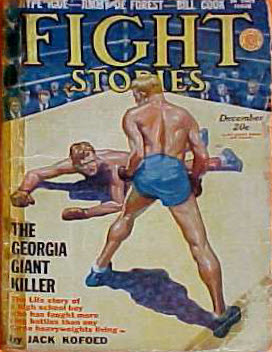
William Henry Cook, the Managing Editor, was born in Jersey City, New Jersey, October 8, 1888. He was 2 years older than the Major. Unlike some of the younger artists starting out, Cook’s involvement in the magazines was from a professional background in writing content for catalogues and according to the 1920 census as a “publicity clerk.”
Cook sold his first pulp story to Ace-High Magazine in 1923 and continued writing for the pulps for 20 years. Most of his stories appeared in Sport Story Magazine and Fight Stories. His stories that appeared in the comics magazines are well-crafted but don’t have MWN’s level of creative skill. Most of the Major’s stories appeared in the better pulps such as Adventure and Argosy.
The Mystery of the Gold Pieces” a short story by Wallace Kirk (William Cook) in New Comics #3 is an example. The style of writing is the same and Wallace Kirk shows up immediately in The Comics Magazine with a new story. There is no one of that name to be found on any of the pulp lists as a writer thus I surmise Kirk is Cook.
The story is fairly simple and well-written but not particularly intriguing. The ending is disappointing as the bad guy turns out to be the poor janitor, a black man, who takes the rap for stealing the gold. It comes across as a simplistic and racist choice since there is no indication that the janitor’s original character had the stated required facility to steal the gold.
There is an interesting line in the story: “Was it a ghost or the grim shadow of a superman that haunted the steel-clad of the State Line Bank?” Who knows whether this was in the zeitgeist or an awareness of Siegel and Shuster’s work in progress.
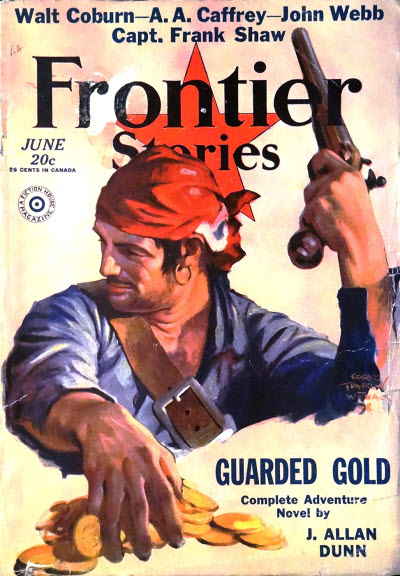
Alex Jay in his excellent blog, “Tenth Letter of the Alphabet” notes an item that appeared in The New York Times March 25, 1929 in which Fiction House, Inc. bought Frontier Stories from Doubleday and that “William Henry Cook will be the new managing editor of the magazine…” That also indicates a solid background as a managing editor.
It’s probable that Cook and MWN knew of one another through their similar publishing connections. MWN needed that kind of professional support especially at this juncture. Cook ultimately did not provide that support.
John Francis Mahon was born in Shenandoah, Pennsylvania, October 28, 1897. He grew up in New Haven, Connecticut and by 1930 the family had moved to the Bronx. Mahon held a number of sales positions and then according to David Saunders went to work for Eastern Distributing Company.
It was a small world indeed. The company was owned by Walter A. Angel and Paul Sampliner with whatever hand Harry Donenfeld had in the mix. It’s not clear how Mahon and Cook knew one another prior to their work for the Major since Mahon did not appear on the masthead of the Major’s magazines until December 1935 several months after Cook.
My guess is that it was due to William J. Delaney, the new advertising manager and one of the characters from this era who keeps appearing in various parts of the story and probably manipulating events for financial reasons. It’s always about the money.
Frontier Stories, June 1929. Cover Edgar Allan Wittmack
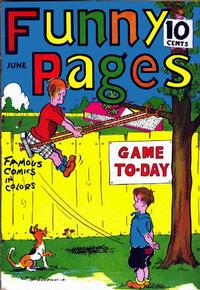
After leaving MWN’s company, Cook and Mahon started The Comics Magazine. Apparently, their combined business sense didn’t help in the face of the odds since their magazine was bought within several months by Ultem Publications with Harry Chesler as managing editor.
Jay states in his blog posting on Cook: “The Comics Magazine Company’s last issues had the cover date June 1937. These issues appeared soon after this bankruptcy notice in the New York Times, February 6, 1937: William H. Cook, editor, 70 W. 11th St.—Liabilities, $16,486; no assets.” Why, only Cook and not Mahon?
From his 1942 WWII draft card Cook was unemployed and living in Sheffield, MA. So far there is no indication that Cook was involved in publishing after his last pulp story in 1943. William H. Cook died June 16, 1964 in Chester, Vermont.
His story seems sad as he obviously had big ideas but wasn’t able to manifest them. My sense is that like the Major he may have been manipulated and used by others and then left to deal with the pieces on his own. That easily could have been the ending to the Major’s story but it wasn’t and therein lies the measure of the man.
Since Cook seemed to flounder after their comics magazine was bought out and Mahon appeared to continue working in the business side of publishing, it’s possible their connection was solely a business venture. There is little information about Mahon’s career after the 1940’s.
Mahon listed his occupation as Magazine Publisher working on his own in the 1940 census. According to his 1942 draft card he was again employed by Five Star Publishing Company Inc. and further listed Larry Symonds, at the same address as someone who would always know his whereabouts. I’m interested in that connection to pulps and the distributors and will keep looking for more information. John Francis Mahon died in Shelton, CT in 1967.
The Comics Magazine (Funny Pages) Cover John Patterson
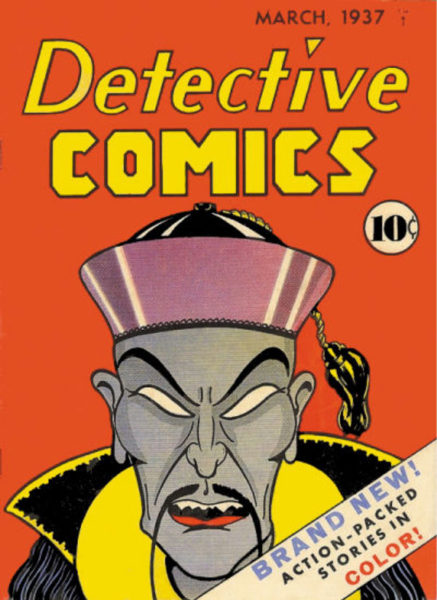
Meanwhile the Major continued publishing his magazines, including in 1937 bringing out Detective Comics. Comparing the two, the Major’s magazines are of superior content and quality. In spite of the financial difficulties that he and others faced in attempting to publish original comics he held fast and continued to innovate. I’ll go into more depth with New Comics #4. There is much more to be gleaned from this episode.
The first page of New Comics #3 is a message from the editor. It is multi-colored featuring different characters from the different comics. Vin Sullivan’s signature as “Vin” appears at the bottom right-hand corner. GCD (Grand Comics Database) concludes that Sullivan drew all the characters in the “style” of the other artists. If so, that signifies Sullivan’s first-rate ability as an artist.
“Copyright 1935 National Allied Newspaper Syndicate, Inc. Great Britain Rights Reserved” appears on every page.
The ad revenue is similar to the previous magazines. There are two large ads on the inside cover. The Gilbert Chemistry Set from Pastime Novelty suggests “Now is the time for a chemistry set. On the same page the Crowell Publishing Company is looking for boys to deliver magazines with prizes they can win. “This Bike can be Yours.” There is a one-half column ad for The House of Magic, A. G. Steen on the “It’s Magic” page and on the following page a small ad for Max Mehl coin dealer.
A larger ad next to it from The Universal Toy & Novelty Mfg. Co. offers a special deal of novelties for readers of New Comics with the enticing “say, how’d you like a package of jimcracks.” According to Webster’s, Jimcracks (gimcracks) is an attractive bauble of little use. I wonder if the word had other meanings during that period. Presumably this ad would have only appeared in these magazines.
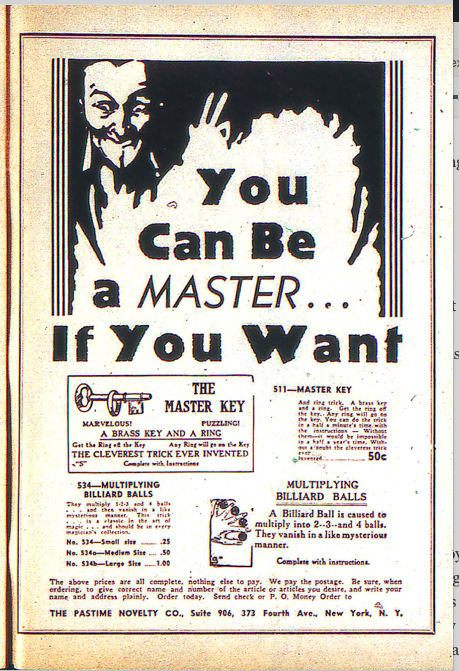
A small ad on “The Radio Dialer” page from the Wilson Chemical Co. is too blurry to read but appears to ask for boys and men to deliver free samples. The Inside back cover has a large ad for The Pastime Novelty Company offering The Master Key and multiplying billiard balls. I have no idea why anyone would want multiplying billiard balls. The back-cover features Remington Typewriter. As noted in my post on More Fun #8, with William J. Delaney in charge of advertising, the large ads were likely placed in many magazines.
There are a couple of promotional ads for the comics magazines themselves. A large ad for More Fun suggests that “More than 500,000 people approve of this Ten Cent Magazine of Comics.”
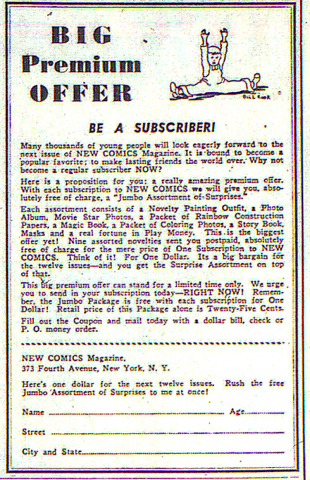
On the same page with the promotional offering of “jimcracks” from Universal Toy & Mfg. Co. is a large promotional ad for subscriptions to New Comics. The ad has a drawing by Bill Cook—nowhere near the skill of Dick Loederer.
With each new subscription, the reader receives “a Novelty Painting Outfit, a Photo Album, Movie Star Photos, A packet of Rainbow Construction papers, A Magic Book, A packet of coloring Photos, a Story Book, Masks and a real fortune in play money.”
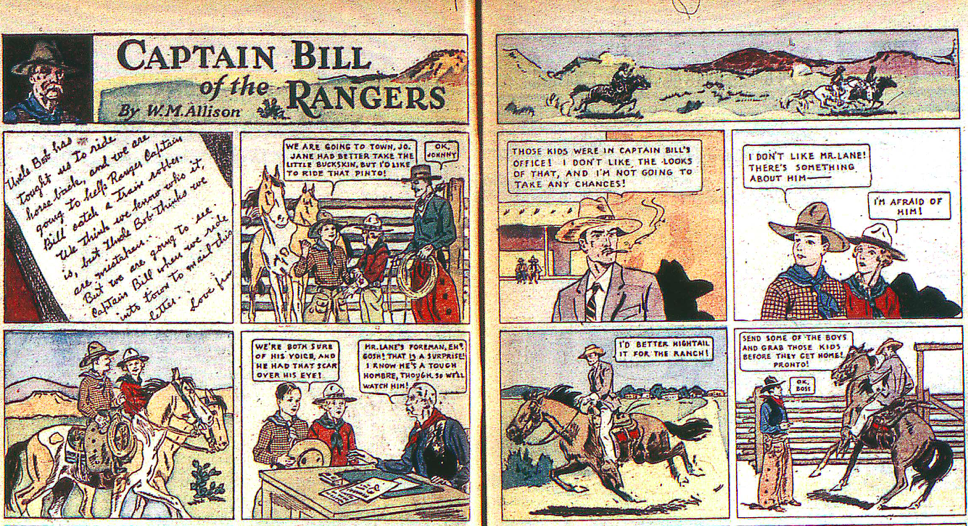
The first two-page comic, “Captain Bill of the Rangers,” is by W.M. Allison (William Merle) in color. It continues the story of Jim and Jane visiting their Uncle Bob out west. They recognize the train robber and go into town to tell Captain Bill. Mr. Lane from the ranch next door follows them into town, asks them to come visit his ranch and has his men kidnap them as they ride back to their Uncle Bob’s ranch.
Allison’s artwork features strong pencils and is appealing. It’s a well told adventure story reminiscent of the Hardy Boys, etc. from that time period. This was Allison’s last appearance in the Major’s magazines. The story continued in Cook and Mahon’s The Comics Magazine as “Captain Bill of the Rangers” for four pages. It did not appear in the 2nd issue of The Comics Magazine but returned for the next 3 issues as “The Further Adventures of Jane and Johnny.”
The GCD refers to the strips in The Comics Magazine as “borrowed” from New Comics. I’m not sure what that means. Since the story continued in The Comics Magazine it doesn’t seem to be borrowed. Just to make things even more confusing, the story continued as Captain Jim of the Texas Rangers by Homer Fleming in New Comics #4.
Since the Major honored creators’ rights, it seems that the idea for the Captain Bill story may have been the Major’s. The clue to many of these confusing issues of why a comic appeared in one magazine and then another can be resolved by looking at the Major’s belief in creator rights. If a comic was originally created by the artist, then the contract was for North American serial rights and once published the rights deferred back to the creator.
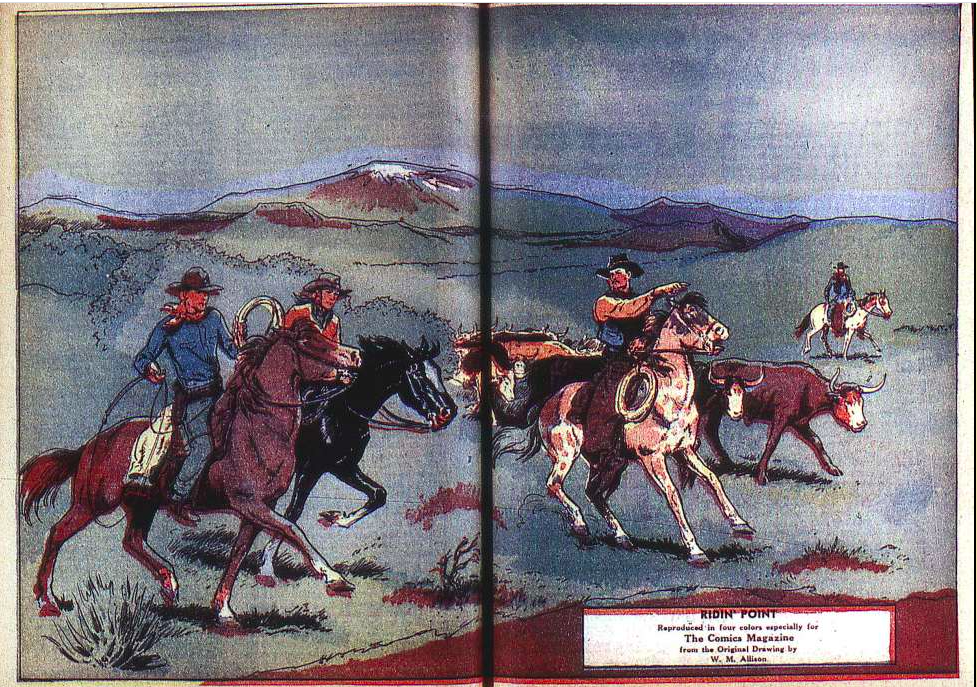
William Merle Allison was born January 27, 1880 in Ottawa, Kansas. He would have been about 55 years old in 1935 so hardly a newcomer. He had a long career in illustration for advertising, books and pulps. After studying at the John Herron Art Institute in Indianapolis and the Chicago Academy of Fine Arts, he and his widowed mother moved to New York City.
Allison worked as an illustrator for advertising and illustrated a number of pulp magazines beginning in June 1917 until November 1940. Most of the pulps he illustrated were westerns. He began his work in comics in New Comics #2 and #3 for the Major and then went on to provide comics mostly of the western genre for a number of comics magazines for about 20 years.
I love Allison’s artwork. It is superior in quality and he deserves more notice. Some of his western illustrations could easily be stand-alone paintings. William Merle Allison died in New York in 1964.
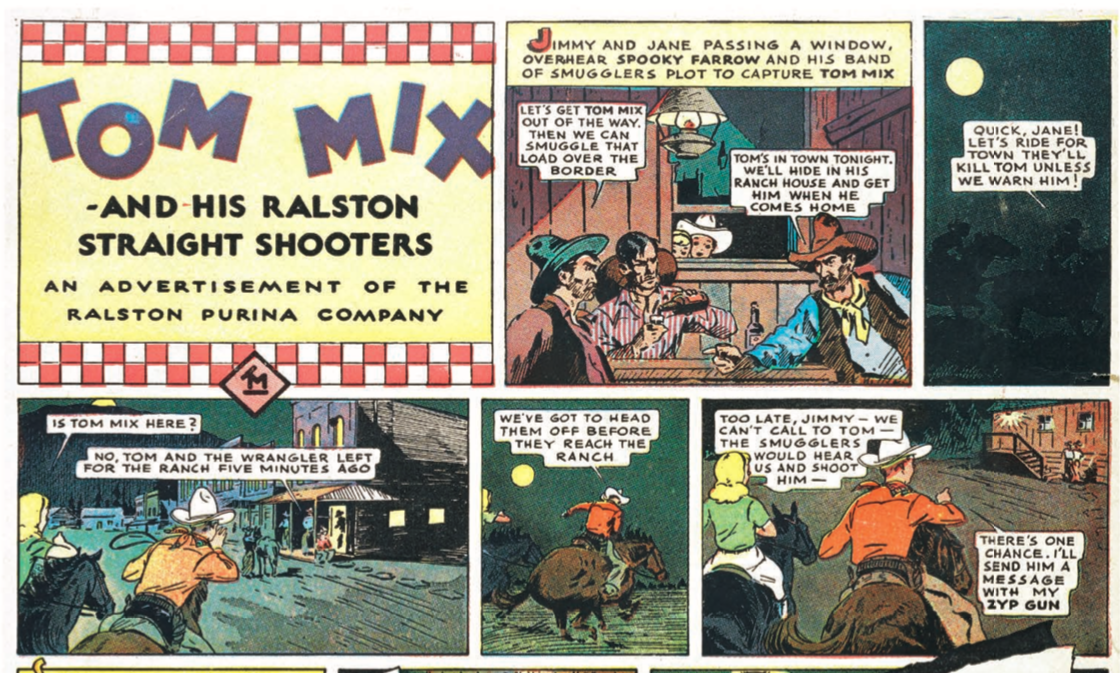
Another Mystery solved. One of the mysteries I have been attempting to solve is finding the artist for the Tom Mix Ralston ads that appeared on the back covers of New Fun #1 and 2. Besides looking in the usual places I sent out several queries to supposed experts without luck.
Just recently that information appeared on a couple of sites as William Merle Allison. I’m interested in the source of that information. However, comparing the artwork, lettering, storyline and dialogue it seems pretty solid. The storyline for the ads is similar to the storyline for the comic strip and there are two children named Jimmy and Jane. That was probably Allison’s entrée to the magazines.
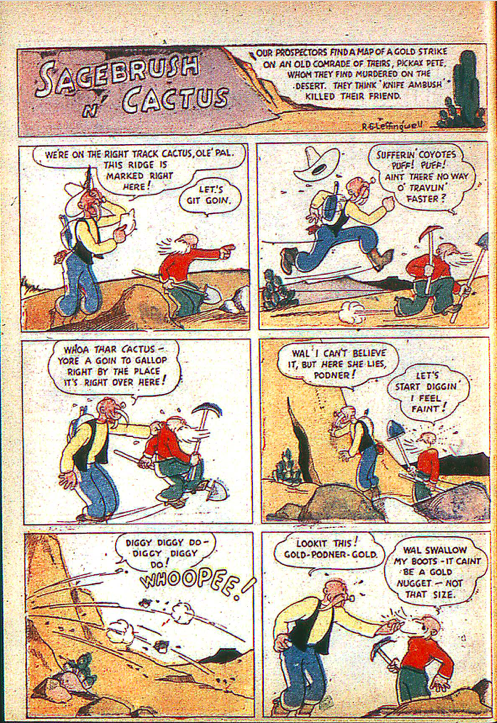
R. G. Leffingwell had two continuing comics–“Sir Loin of Beef” and “Sagebrush and Cactus.” Both in color and both 2 pages each. Our characters Sir Loin and Cowhide attempt to nap after a hearty meal. Young Hash is annoyed as he wants to play. He finds some stones and with his slingshot continues to interrupt their naps. They tie him up and resume their nap. This comic seems aimed at younger children as the story is simple and rather silly. I’m not so sure that tying up young Hash would be acceptable today.
My favorite of Leffingwell’s comics “Sagebrush and Cactus,” is the continuing story of the gold miners–Sagebrush and Cactus. In this chapter they find the mine of gold, hide the entrance and head for town. The dialogue and illustrations provide a pretty good clue of what will happen and I look forward to the next installment.
To leave a reader wanting more 85 years later firmly establishes Leffingwell’s skill as a comics artist. The artwork is solid and I love the wide-open spaces of the western scenes. The characters are strong and likeable and the story is interesting.
In addition, Leffingwell contributed a filler strip, in color, of “Fanny,” the mule, who has previously appeared in fillers and as a character in “Sagebrush and Cactus.” There is no dialogue. Fanny is hit on the head by an apple. She kicks the tree and another apple falls on her head. Her kicking ability figures in the plot of “Sagebrush n Cactus.”
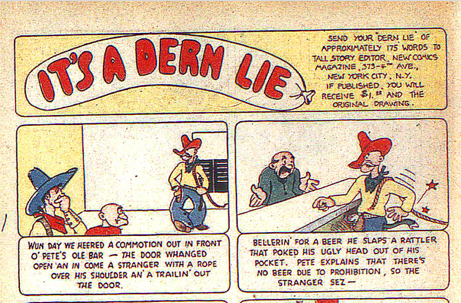
Leffingwell also did the artwork for the ongoing reader activity, “It’s a Dern Lie” in color. Unlike previous stories there is no reader byline so the tall tale was probably written by him.
Besides acting as assistant editor, drawing the cover and the artwork for the editor’s page, Vin Sullivan had 3 comics and a one-page filler. “Jibby Jones” appears in a one-page comic in color. A bully is after Jibby because Jibby has called him a dope. He chases Jibby into a dead-end alley and plans to sock Jibby. The last panel shows the bully knocked out on the ground but it’s not clear what happened. The artwork continues to be solid.
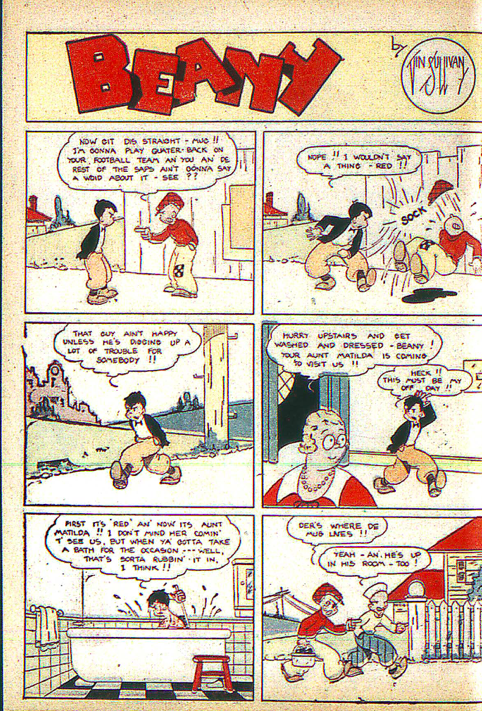
“Beany” makes his second appearance in color in a two-page comic by Vin Sullivan. The character and storyline are similar to Jibby Jones. Beany gets into a fight with the local bully. He comes home and has to take a bath because his aunt is coming to visit. The bully and his henchman put a ladder against Beany’s house and throw rotten tomatoes at him after he is clean and dressed. Beany comes downstairs to meet his aunt covered in rotten tomatoes.
The artwork is Sullivan’s usual high quality but the story is not all that interesting. Perhaps it was aimed for young children.
“Licorice” is a new character with a one-page comic in color by Vin Sullivan. The name of the character is bad enough and unfortunately it is a negative stereotypical depiction of a young black child. It begins to rain and Licorice ends up in an enormous Mexican hat. Once it stops raining his friend asks him why he can’t take off the hat and he explains his clothes are drying.
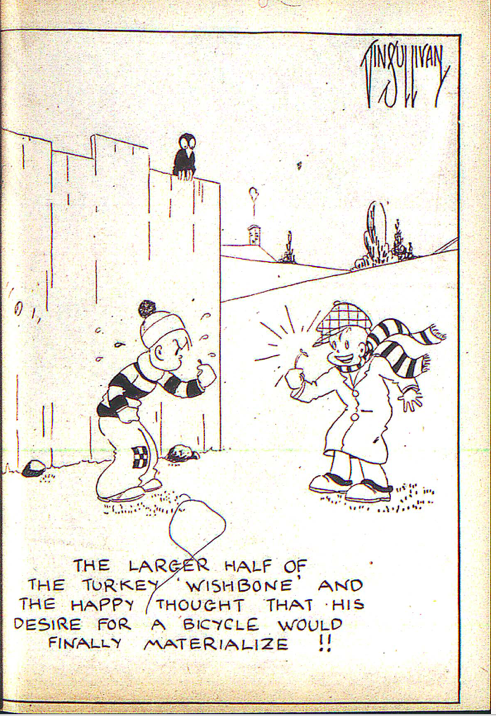
Sullivan also has a full-page illustration in black and white for what would normally be a one panel cartoon. One of the characters looks similar to Jibby Jones and it’s a simple joke about a wishbone. The drawing looks unfinished and was one of the clues of the obvious need to fill pages.
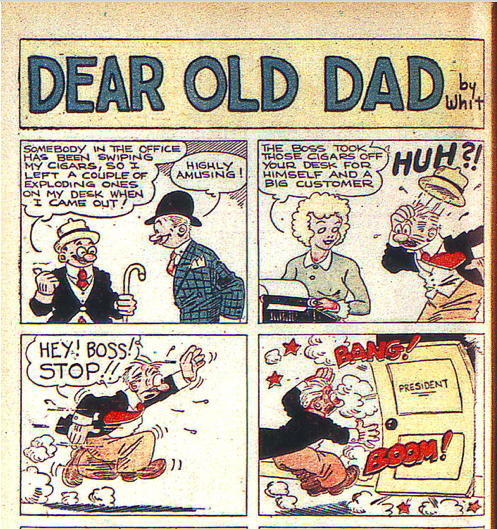
Whit Ellsworth has two comics, “Billy the Kid,” a continuing character and a new character “Dear Old Dad” that seems derivative of other comics of the period. In “Billy the Kid,” a one-page comic in color, Billy’s friend wants to play “Fencing” with wooden swords. Billy prefers fists. His friend keeps smacking him with the sword repeating “en garde” and “tooshay” until Billy punches him and yells Tooshay.
Ellsworth’s draftsmanship is good but doesn’t particularly stand out and his storylines are not that interesting. Perhaps these were also aimed at younger kids.
“Dear Old Dad” by Whit is a one-page comic in color. This storyline has a more solid joke. Dad leaves exploding cigars on his desk because someone has been taking his. The boss and a new client help themselves with the unsurprising results. In the last panel Dad is seen at the Employment office.
Ellsworth also had what was probably another filler in a two-page feature in color, “The Circus is Coming” by Whit Ellsworth consisting of two pages of one panel jokes about the circus and the various acts.
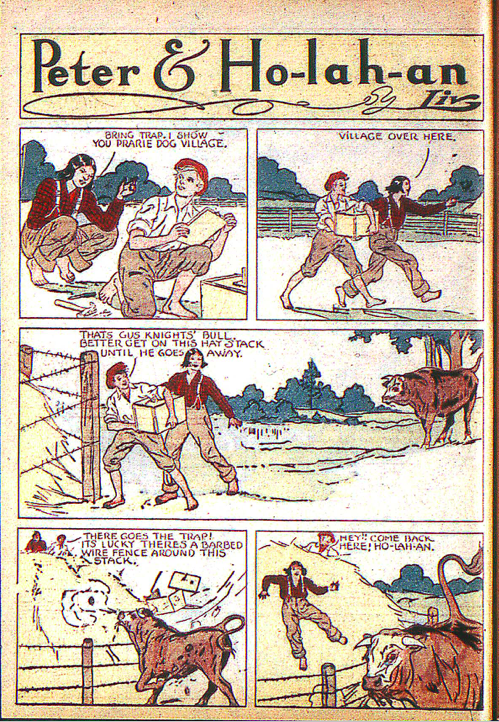
Rolland Livingstone makes his final appearance in the Major’s magazine with his comic “Peter & Ho-Lah-an,” by Livingstone and his illustrations of “The Vikings” from a script most likely by MWN.
Both are two pages each and in color. In this episode of “Peter & Ho-Lah-an,” Ho-lah-an tells Peter that he has a trap to catch a prairie dog. They reach the prairie dog village only to have the farmer’s bull chase them. Ho-lah-an pulls the bull by the tail and the bull tries to run away.
Peter tells Ho-lah-an he’ll be a big chief someday. Although the story features Ho-lah-an in a positive manner, he speaks in stereotypical short sentences straight out of Hollywood casting. The artwork is fluid and consistently attractive in an illustrative manner.
To be continued: New Comics #3–Part 2.