
Slam Bradley--DC Comics' Detective Hero
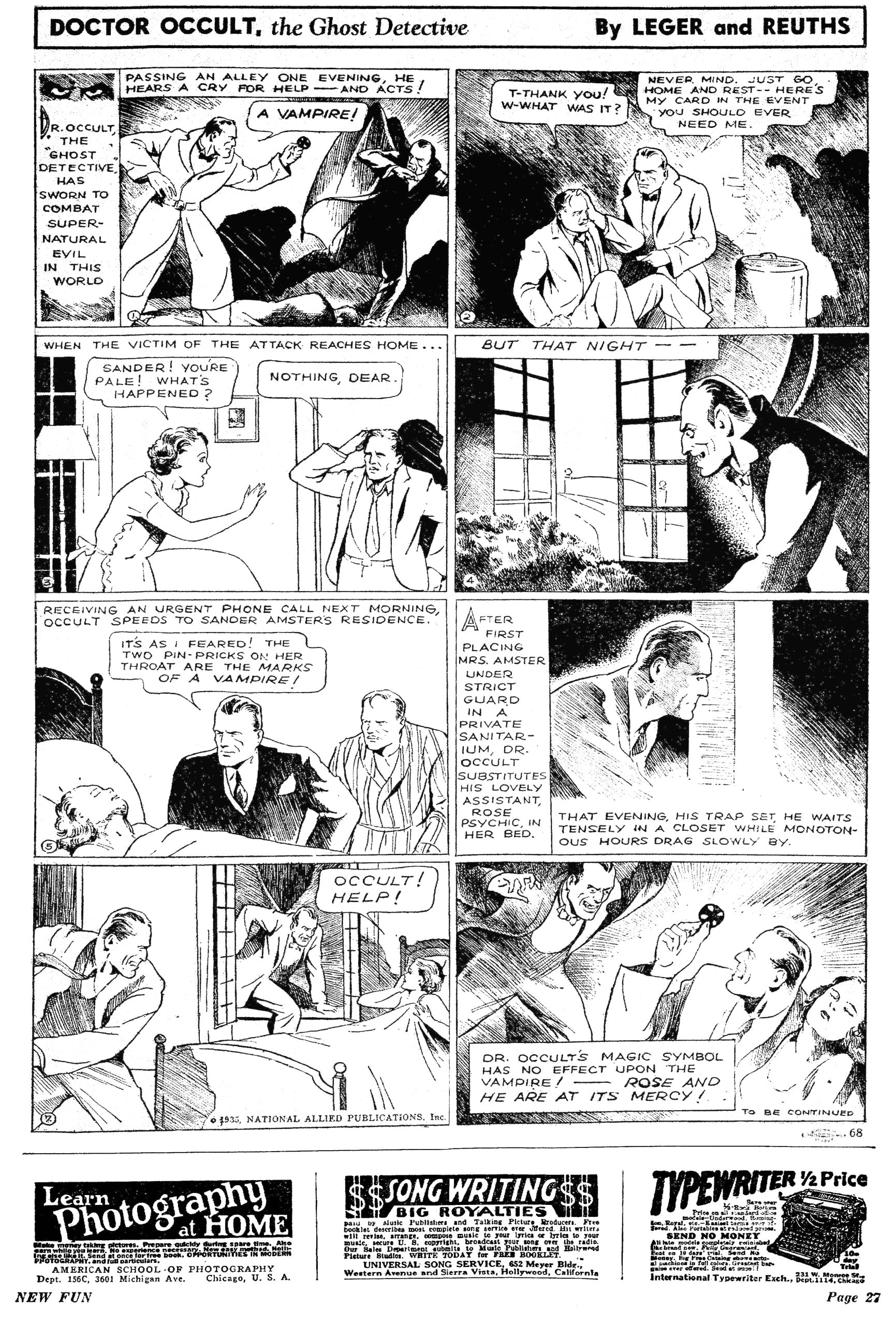
Jerry Siegel and Joe Shuster made their debut in Major Malcolm Wheeler-Nicholson’s Comics magazine, New Fun #6, appearing on newsstands, September 13, 1935 with an October cover. Apparently, Siegel sent in unsolicited material including an early Superman drawing on butcher paper. The two contributions of Siegel and Shuster that appeared in New Fun #6 were “Henri Duval” and, as Leger and Reuths, “Dr. Occult, the Ghost Detective.”
The Major created the first DC Comics magazine with all original comics, New Fun in January 1935 followed by a second magazine, More Fun, in January 1936. Recognizing Siegel and Shuster’s talent he encouraged them. After that first appearance in New Fun, Wheeler-Nicholson wrote to Siegel on October 4, 1935. He proposed a comic for the next new comics magazine, New Comics, which would later become Adventure Comics.
“Our suggestion is that you do a four-page strip in the narrative line, calling it the Federal Men. This strip should be a fast moving radio patrol-automobile G-Man strip with plenty of excitement and adventure with virtue triumphing as usual. This is our present need, but we are always glad to get other suggestions or ideas from you.”
Dr. Occult, Siegel & Shuster as Leger and Reuths, New Fun #6
Despite my ongoing crusade to set the record straight, Siegel and Shuster are usually cited as the creators of Slam Bradley. The creator of Slam Bradley was Major Malcolm Wheeler-Nicholson and Siegel and Shuster are the co-creators. Six months after creating Federal Men, “the Major,” communicated to Jerry Siegel in a letter dated May 13, 1936. He described a new magazine to be published, which would become Detective Comics.
“It will contain longer stories and fewer. From you and Shuster we need sixteen pages monthly. We want a detective hero called “Slam Bradley.” He is to be an amateur, called in by the police to help unravel difficult cases. He should combine both brains and brawn, be able to think quickly and reason cleverly and able as well to slam bang his way out of a bar room brawl or mob attack. Take every opportunity to show him in a torn shirt with swelling biceps and powerful torso ala Flash Gordon. The pages are to run the same size as New Comics but to contain eight panels a page instead of six.”
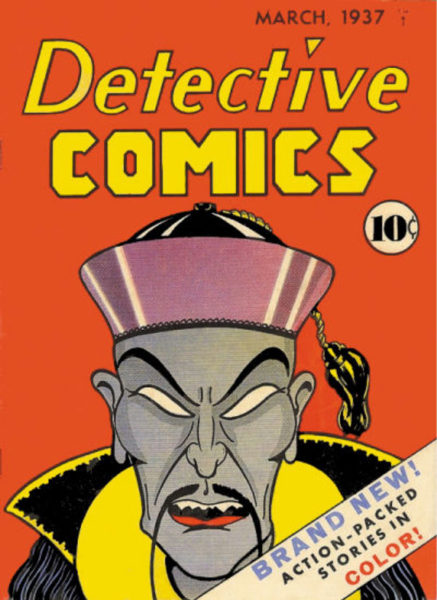
Detective Comics #1. Cover: Vin Sullivan
Slam Bradley made his appearance in Detective Comics #1 appearing on newsstands February 25, 1937 with a March cover date. The Major’s idea for Detective Comics was to have a magazine with a theme rather than the various comics and non-comic material in the previous New Fun, More Fun and New Comic magazines. This concept was a direct evolution from the adventure pulps the Major had written for and with which he was familiar.
In an article published in a trade magazine, in 1957, Lloyd Jacquet, the initial editor for the first four New Funs noted, “Now, we had a little book shelf in the Major’s office, in lieu of files, and on it were placed some of the new ideas which [we] were constantly cooking up for our new-found magazine business. These ideas were rough dummies of other comic books that we wistfully wished we could publish. Major Nicholson’s pulp magazine background helped here for it was a natural step from the “general” title of comics (of the funny type, incidentally), to the western, and the detective, aviation, and so forth, that were even then the backbone of the pulp mag sales on the newsstands all over.”
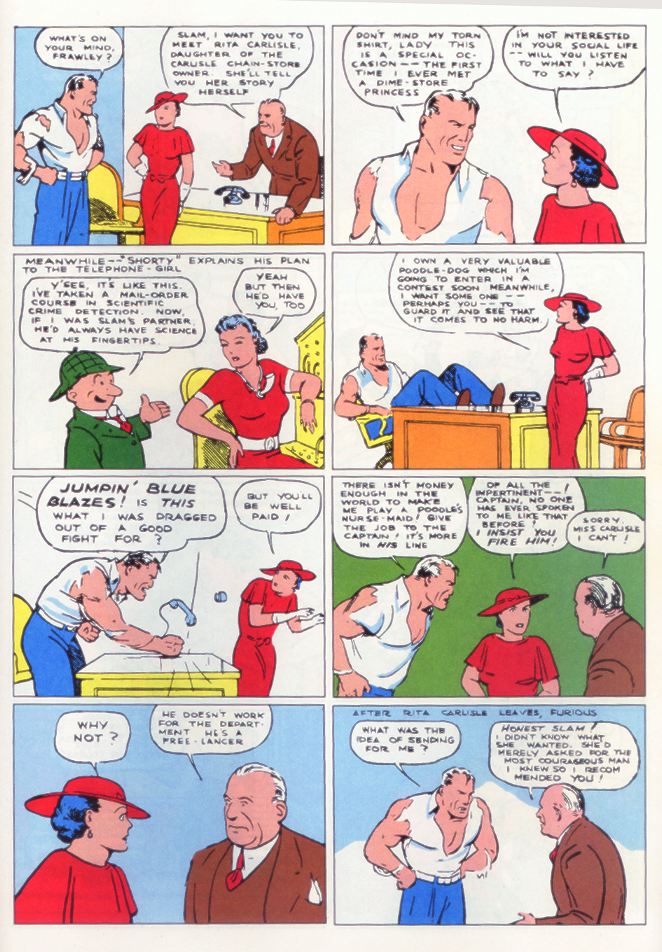
Slam Bradley, Siegel & Shuster. Detective #1
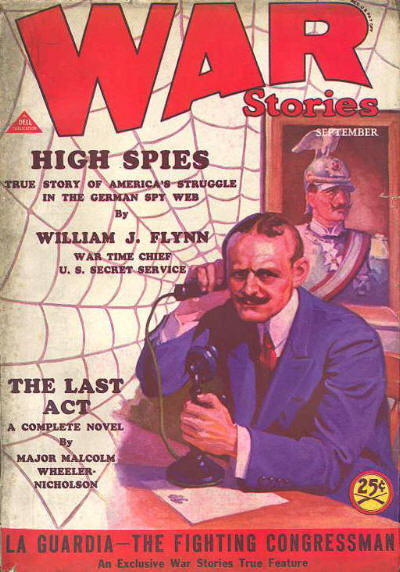
The “pulp” magazines referred to were so-called due to the pulp paper upon which they were printed—not necessarily the content within. These magazines filled with short stories, novellas and novels, began in the US market with Argosy magazine in 1896 and proliferated with 100s of titles ranging from Spicy Detective to the pulps aimed at general readers, such as Adventure, Argosy, Short Stories and many more.
Wheeler-Nicholson wrote for the adventure pulps beginning in 1924 and continued until 1956. Almost everyone, including Harry Donenfeld, involved in the emerging comics industry was in one way or another tied to the pulp industry as writers, artists, editors, salesmen, distributors and publishers.
The Major was one of the few early publishers who had a creative background as a writer for adventure pulps and publisher of a newspaper syndicate in 1926 that also contained comics and the first classical comics series.
War Stories, September 1931
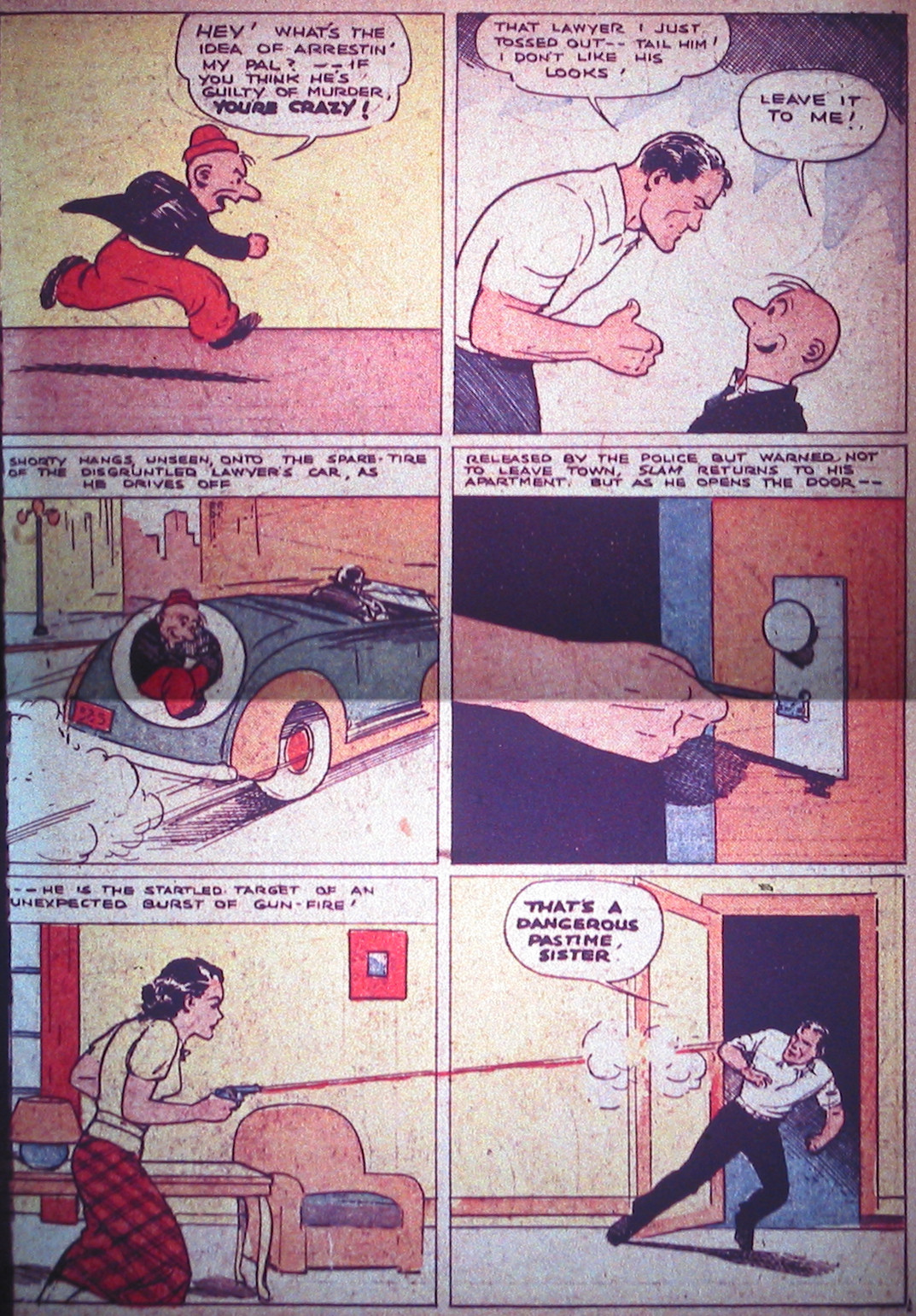
Slam Bradley was a direct descendent from the same pulp adventure stories as well as the heroes found in the newspaper comics of the day. He was a classic hero, handsome with a good physique, quick on his feet and in thought, able to handle any adversity, often single-handedly.
In the original Siegel and Shuster stories beginning in Detective Comics #1, March 1937 and continuing through the Major’s period to Detective Comics #13, March 1938, the plots were simple with a villain or two and the ability of Slam to both outsmart the bad guys and overcome them physically.
This kind of straightforward behavior would appear as well in the character of Superman. As has often been stated, Superman is always good. So too, was Slam Bradley. There was no equivocation, no angst as to motivation. Slam Bradley was there to make things right, to see that justice prevailed.
His comical sidekick, Shorty, was Siegel’s addition to the stories and an indication of Siegel’s sense of humor. That same sense of humor would surface again in Funnyman, in six issues from January 1948 through August 1948 published by Magazine Enterprises, Inc.
Slam Bradley, Siegel & Shuster. Detective Comics #2
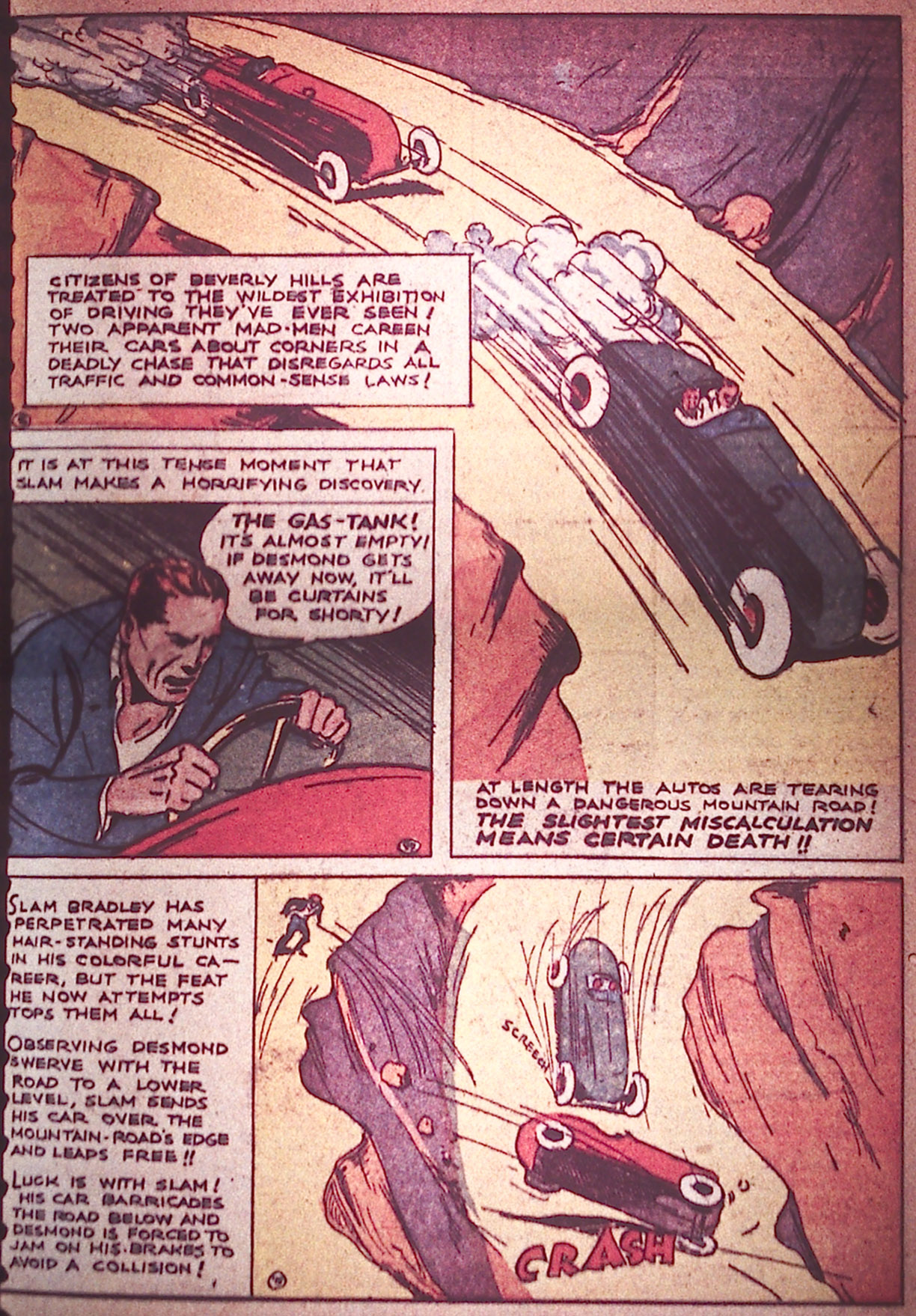
Shuster’s artwork in these early magazines is some of his best. His artwork quickly developed, moving away from flat one-dimensional representation to different perspectives that are cinematic in nature. The car chase in Detective Comics #4, June 1937, “The Hollywood Murders” winds around mountain roads with no establishing shot giving us the sense of the dizzying pace and danger.
The stories also frequently show Slam in the air, high above the earth. In “The Hollywood Murders,” Slam and Shorty are hired as stuntmen. The first pages show Slam leaping from a platform and swinging from ropes. The last scenes of the story referred to as [Skyscraper Death] in Detective Comics #2 April 1937, take place on a skyscraper. The perspective is slanted with no sense of the horizon. It’s as if we are hanging on to the ropes with Slam.
And again, in Detective Comics #9 November 1937, in the story referred to as [The Human Fly] Slam Bradley finds himself high above the earth climbing a skyscraper, chasing a thief. The artwork is exciting and evocative. Looking at those initial Shuster drawings, it’s easy to see the transference to the Superman stories not just in the action but also because Slam resembled Superman in look and physique.
Slam Bradley, Siegel & Shuster. Detective Comics #4
The Major was ousted from his company, Nicholson Publishing, Inc. in March 1938 through a forced bankruptcy that was finalized by September 1938. It was brought by his own partners, Harry Donenfeld and Jack Liebowitz.
Under the new publishers Donenfeld and Liebowitz, in addition to the Superman stories, Siegel and Shuster continued with the Slam Bradley stories in Detective Comics from April 1938 until June 1939, Detective Comics #14–Detective Comics #28.
However, by Detective Comics #25, Shuster’s problems with his eyesight and work load necessitated using other artists. Wayne Boring who was at the Siegel Shuster studio in 1939 began to assist Shuster with the artwork. Boring was hired by DC in 1942 and by 1950 was one of the main artists for Superman.
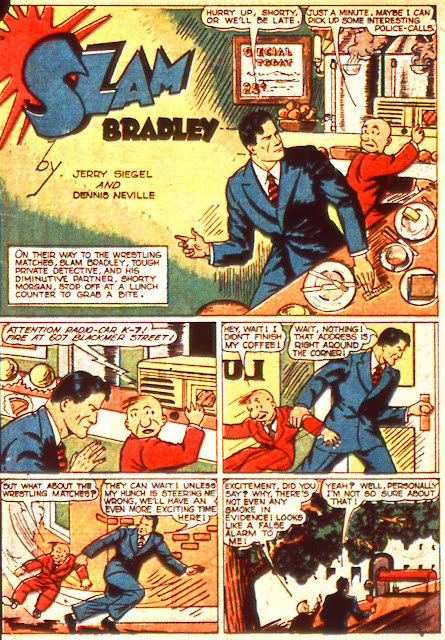
Mart Bailey and Dennis Neville also contributed as artists to the Slam stories with Jerry Siegel as the writer in Detective Comics #33—Detective Comics #39. Neville’s artwork is particularly nice and gives Slam a Clark Kent look thus the ongoing connection to Superman.
Slam Bradley, Siegel & Neville. Detective Comics #38. Image from Steve Thompson blog.
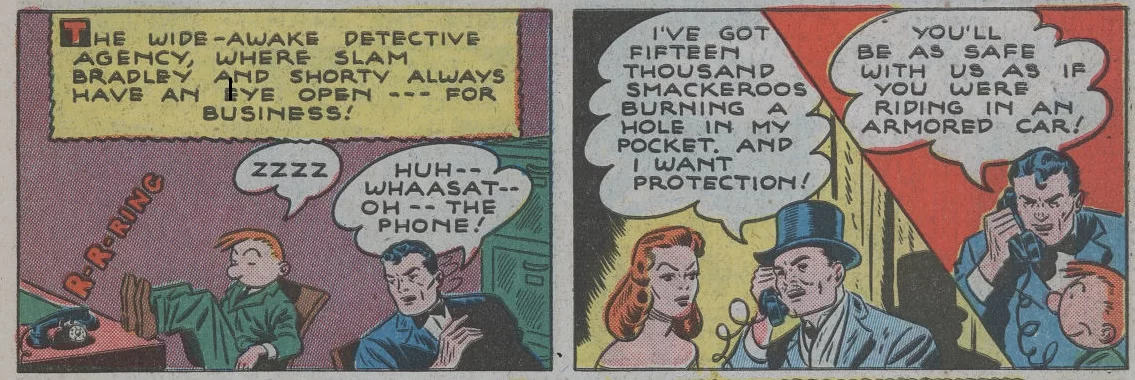
Siegel then teamed up with artist Howard Sherman in Detective Comics #40, June 1940. Their collaboration lasted through Detective Comics #55, September 1941 when Sherman continued drawing Slam with no writer listed.
Sherman stayed with the Slam stories for a long run through Detective Comics #152, October 1949 with Martin Naydel and John Daly also contributing throughout this period. Sherman’s artwork and style moves away from the somewhat art deco style of the early stories with strong sharp lines and it’s easy to see why he often did the artwork.
The Slam stories throughout this period appear to follow the usual formula whoever may have written them. Pulp, comics historian, and author William Murray suggests that it may have been Gardner Fox.
Bob Hughes, comics historian and author has suggested Joe Samachson for several of the later stories during 1943. Samachson was a research chemist who also wrote for both pulps and comics including stories for Batman and Superman.
Slam Bradley, Howard Sherman, Detective Comics #59. Image from I.M. Baytor blog.
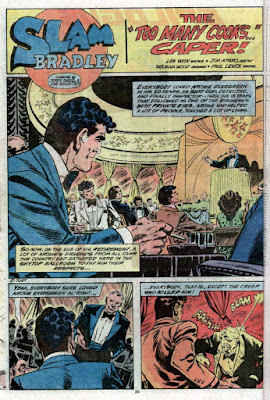
Amateur detective Slam Bradley had a long run in DC Comics from that first story in Detective Comics #1 in 1935 to what appears to be the last of that period in Detective Comics #152, “Too Many Morgans” with artwork by Howard Sherman. Slam was seen off and on in the 1980’s and early 1991 even appearing in a Superman story.
He reappeared in April 1981 in Detective Comics #500 entitled “The 500th Anniversary Celebration of Detective Comics. Written by Len Wein with pencils and inks by Joe Aparo, Slam was showcased in “The “Too Many Cooks…” Caper!”
Slam Bradley, Wein & Aparo, Detective Comics #500. Image from Daves Comics Heroes blog.
Batman appeared on the cover of Detective Comics #27 May 1939 and became the main character for the Detective Comics magazines with Superman appearing in his own titles. It’s not surprising that Slam would be absorbed into the Batman universe.
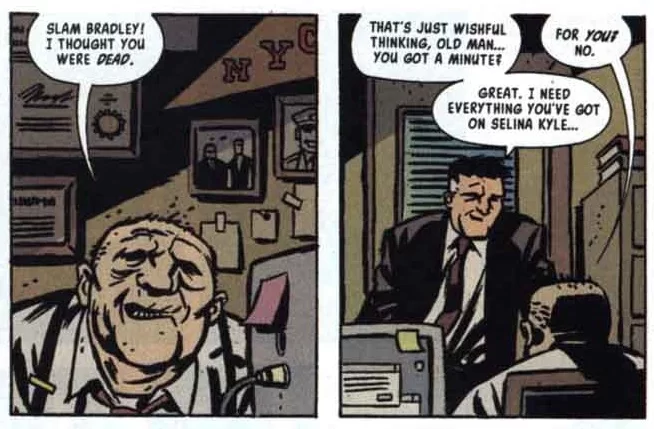
In Detective Comics #759 August 2001, Ed Brubaker as writer and Darwyn Cooke as artist resurrected Slam as a more noir character in a four-part series, “Trail of the Catwoman.” Slam is hired by the mayor of Gotham to find out if Catwoman has died or is still living. Slam is older and jaded. He’s seen some of the worst of life and it shows.
The collaboration of Brubaker and Cooke is some of the best of the Slam stories for a new audience. Brubaker’s noir writing style with Cooke’s artwork that is evocative of early comics and at the same time truly unique is outstanding. Slam has continued to appear in stories in the Catwoman series and other parts of the Batman universe.
Trail of the Catwoman, Brubaker & Cooke, Detective Comics #760.
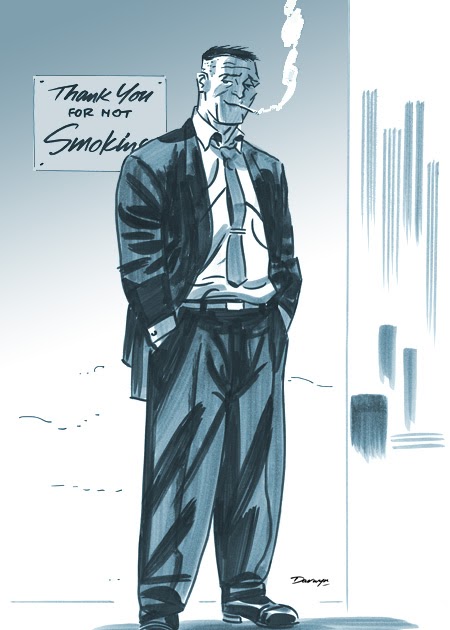
Of all the characters that appeared in Detective Comics #1, what is it that made Slam Bradley so durable that he overcame the simplicity of the original stories and 90 years later continues in a more nuanced world?
Part of the answer lies in his archetypal nature. The detective can wear many faces from Sherlock’s cerebral intuitive character to Bogart’s depiction of the noir anti-hero. Whatever the outer character, the detective searches for the clues to find the answer, to bring about justice in one form or another.
Superman is the ultimate superhero and Batman is the ultimate mythic hero descended from the gods–a combination of the superhero and the detective. It is Slam Bradley who embodies the archetypal detective, everyman, who searches for answers. In whatever manner he is envisioned Slam Bradley continues to remain true to the original vision of “the Major” and the original intention of Detective Comics.
Slam Bradley, Darwyn Cooke. Image from Darwyn Cooke blog.
[This post appeared as a shorter essay in PBA Galleries.]
For more on Slam Bradley see: Brad Ricca, Steve Thompson, I.M. Baytor posts.